Fixed Matches Ticket 280 Odds

VIP Ticket with total odds around 280.00
Total of 4 Fixed MatchesVIP Ticket

Next VIP Ticket:
Saturday, June 13, 2026

We provide our service with:
Trust, Security & Professionalism!

Simply contact us to receive full details about pricing and payment methods.
Email: fm365support@gmail.com
Telegram: +41 77 403 8274
Telegram username: @fm365support

After completing your payment, you will receive your VIP Ticket within a maximum of 30 minutes.

Your ticket includes a total odds of around 280.00, based on 4 carefully selected matches.


Last VIP Ticket:
Saturday, June 06, 2026
Result: WON

06.06.2026    Saturday

Verdy vs Gamba Osaka
Tip: BTTS 1st Half    Odds: 5.00    Result: HT 1-1 / FT 2-4 Won

Montevideo City vs Maldonado
Tip: BTTS 1st Half    Odds: 4.00    Result: HT 1-2 / FT 2-4 Won

Acassuso vs Central Norte
Tip: BTTS 1st Half    Odds: 3.50    Result: HT 2-1 / FT 2-1 Won

Vestri vs Volsungur
Tip: BTTS 1st Half    Odds: 4.00    Result: HT 1-1 / FT 5-1 Won

Total Odds: 280.00 WON

BTTS 1st Half means both teams must score at least one goal in the first half.
For example, a minimum 1-1 score in the first half wins the bet, as both teams must score at least once.


VIP Ticket Bet Slip Example
Saturday, June 06, 2026

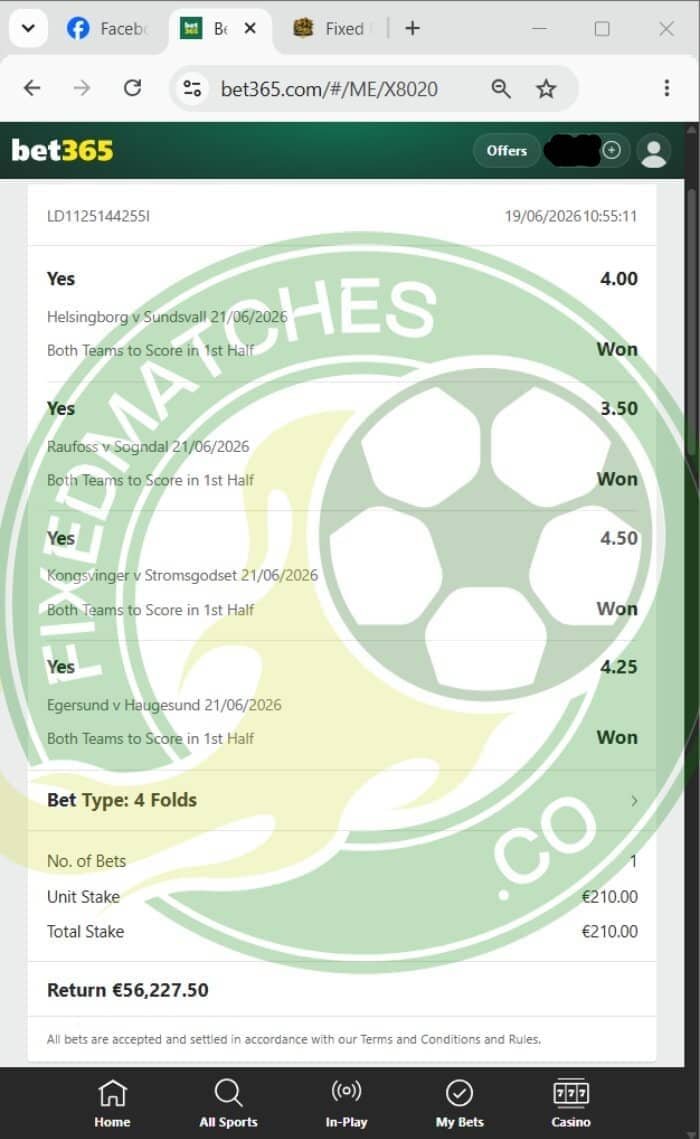
The bet slip below is a real example of our 4 fixed matches.
Some tickets are provided by our team, while others are shared by our clients.

Betting Football VIP Ticket 4 Matches 2026

Explore our VIP Ticket History to see more results and real bet slip examples from previous tickets.

Updated: June 9, 2026 — 12:31 pm

Daily Predictions Free Tips June 2026

13.06.2026 Saturday

Chile Liga de Primera
Colo Colo vs Cobresal
Tip: Over 2.5 Goals
Odds: 1.50
Result: ?:?

12.06.2026 Friday

Iceland Division 1
Throttur vs Kopavogur
Tip: Over 2.5 Goals
Odds: 1.50
Result: ?:?

11.06.2026 Thursday

Sweden Svenska Cupen
Frolunda vs Onsala
Tip: Over 2.5 Goals
Odds: 1.50
Result: 4:2 Won

10.06.2026 Wednesday

Sweden Superettan
Varberg vs Norrby
Tip: Over 2.5 Goals
Odds: 1.80
Result: 2:0 Lost

09.06.2026 Tuesday

Sweden Superettan
Sandviken vs Falkenberg
Tip: Over 2.5 Goals
Odds: 1.80
Result: 4:2 Won

08.06.2026 Monday

There is no free daily match today.
We’ll continue tomorrow.

07.06.2026 Sunday

Norway OBOS Ligaen
Ranheim vs Strommen
Tip: Over 2.5 Goals
Odds: 1.50
Result: 2:2 Won

06.06.2026 Saturday

Iceland Division 1
Vestri vs Volsungur
Tip: Over 2.5 Goals
Odds: 1.50
Result: 5:1 Won

05.06.2026 Friday

Finland Ykkonen
KuPS Akatemia vs KPV Kokkola
Tip: Over 2.5 Goals
Odds: 1.50
Result: 4:1 Won

04.06.2026 Thursday

No free betting tip today.
We will continue with free predictions tomorrow.

03.06.2026 Wednesday

No free predictions available today.
We will resume tomorrow.

02.06.2026 Tuesday

Finland Ykkonen
JJK Jyvaskyla vs VJS
Tip: Over 2.5 Goals
Odds: 1.50
Result: 2:2 Won

01.06.2026 Monday

Romania Superliga
FC Voluntari vs FC Hermannstadt
Tip: Over 1.5 Goals
Odds: 1.50
Result: 3:0 Won

Email: fm365support@gmail.com
Telegram: +41 77 403 8274
Telegram username: @fm365support

Daily Predictions Free Tips June 2026

The reason for our break from April 8 to June 1 is now fully explained. We hope you stay with us so we can keep earning together through our football fixed matches.

Daily Predictions Free Tips June 2026

As many of you already know, we had a short pause from April until the beginning of June. During this period, we continued working without interruption with all our existing subscribers. The pause only affected updates and content publishing on our website.

Throughout this time, we remained fully active and continued providing our football fixed matches betting tips to our loyal clients every day. The temporary break was necessary because we experienced technical issues related to our website, server infrastructure, and development team.

Today, we are pleased to confirm that these issues have been completely resolved. Our new development team has successfully upgraded the website, implemented a new server environment, and optimized our database for better performance and stability.

We can confidently say that everything is now running smoothly and at full capacity. Our team is ready to continue delivering the service you expect, with improved reliability and a stronger platform for the future.

Because of this, we encourage you not to miss this weekend’s VIP Ticket offer. It includes carefully selected football betting tips with combined odds of around 300.00 for this Saturday.

Thank you for your patience, trust, and continued support. We look forward to achieving more successful results together in the weeks and months ahead.

Updated: June 12, 2026 — 8:58 pm

World Cup Fixed Matches History and Controversies

World Cup Fixed Matches and Why People Still Talk About Them

As World Cup 2026 approaches, discussions about football integrity are once again becoming more common. One topic that continues to attract attention is World Cup Fixed Matches. Before discussing some of the most famous examples, readers who are new to this topic may also want to read our article Do Fixed Matches Really Exist, where we explain one of the most common questions in football. Fans, journalists, and historians have debated this subject for decades, especially when controversial matches from past tournaments are involved.

Although FIFA closely monitors suspicious activity and invests significant resources in the fight against Football Match Fixing, several World Cup matches have raised questions over the years. Some of these cases were never officially proven. Others became some of the most controversial moments in World Cup history.

In this article, we will look at several well known examples. Many people link these cases to World Cup Match Fixing theories. They also involve political influence, refereeing controversies, and other incidents that continue to attract attention today. For that reason, football fans still discuss them whenever the topic of Fixed Matches appears.

The Shame of Gijon and the Most Famous World Cup Controversy

When people discuss World Cup Fixed Matches, they almost always mention the match between West Germany and Austria at the 1982 FIFA World Cup. Even today, this game remains one of the most controversial matches in football history. The football community frequently uses it as an example when they discuss Fixed Matches, Football Match Fixing, and suspicious results at major tournaments.

Before the match, the situation was simple. A 1:0 or 2:0 victory for West Germany would send both teams into the next stage. At the same time, Algeria would leave the tournament.

West Germany scored the only goal of the match in the 10th minute. What followed was more than 80 minutes of football with very little attacking intent from either side. Many journalists, fans, and football experts felt they were watching something that resembled a World Cup Match Fixing scenario. Both teams appeared satisfied with the scoreline and showed little interest in changing the result.

However, nobody ever found evidence of an official agreement between the two teams. FIFA could not punish either side because neither team broke any football rules.

The controversy became so significant that FIFA introduced a permanent change. Since then, organisers have scheduled final group stage matches at the same time. They made this decision to reduce the risk of similar situations and potential Fixed Matches scenarios in future tournaments.

World Cup Fixed Matches history and famous football controversies

Argentina vs Peru 6:0 and One of the Most Controversial World Cup Matches Ever

When football fans discuss the most suspicious matches in World Cup history, they almost always mention the 1978 clash between Argentina and Peru. Nobody officially proved that the match was fixed. However, many observers still cite it as one of the most famous examples linked to World Cup Fixed Matches and World Cup Match Fixing theories.

Before the match, Argentina knew exactly what was required. The host nation needed to win by at least four goals in order to move ahead of Brazil and secure a place in the final. The pressure was enormous, especially because the tournament was taking place during a period when Argentina was under military rule and the success of the national team carried significant political importance.

What raised even more questions was the way the match unfolded. Peru had shown decent form earlier in the tournament, but on this occasion the team appeared unusually passive and offered very little resistance. Argentina eventually recorded a convincing 6:0 victory, a result that was exactly enough to send the hosts into the final.

Over the years, numerous Football Match Fixing theories have emerged around this match. Journalists, historians, and former officials have spoken about alleged agreements between the governments of the two countries, including claims involving economic aid, grain shipments, and other political arrangements.

However, despite decades of speculation, no conclusive evidence has ever been presented to prove that the match was part of a World Cup Fixed Matches operation. For that reason, Argentina’s 6:0 win over Peru remains one of the biggest mysteries in World Cup history and one of the most frequently discussed cases whenever people debate Fixed Matches in football’s most important tournament.

South Korea 2002 and the Refereeing Controversies That Still Spark Debate

The 2002 FIFA World Cup is often mentioned in discussions about World Cup Fixed Matches, although the controversy in this case was not about an alleged agreement between teams. Instead, it focused on a series of refereeing decisions that many people believe helped one of the host nations reach the semi finals. More than two decades later, many fans still consider it one of the most controversial tournaments in modern football history.

Most of the debate centres around South Korea’s knockout matches against Italy and Spain. In the Round of 16 against Italy, the referee made several controversial decisions. One of the biggest involved Francesco Totti, who received a red card for simulation. Italian players and supporters strongly disagreed with that decision. They argued that the referee treated their team unfairly throughout the match.

The controversy continued in the quarter final against Spain. The Spanish national team had two goals disallowed following highly disputed decisions, which only increased public suspicion. As a result, many commentators began questioning whether the host nation was receiving favourable treatment during key moments of the tournament.

Particular attention was later directed towards referee Byron Moreno. Years after the World Cup, he was suspended following controversies in Ecuadorian football. He was later arrested in the United States in a case unrelated to the World Cup. These events added further fuel to the various Football Match Fixing and World Cup Match Fixing theories that had already emerged around the tournament.

Although FIFA never accepted the idea of an organised scheme and described the incidents as refereeing mistakes, many football fans still point to the 2002 World Cup whenever discussions about Fixed Matches, World Cup Fixed Matches, and controversial influences on major football tournaments take place.

The 1934 World Cup and the Mussolini Controversy

When historians discuss World Cup Fixed Matches and some of the earliest controversies in World Cup history, they almost always include the 1934 tournament in Italy. The tournament marked only the second World Cup in history. However, many people still consider it one of the most politically charged competitions in football history.

At the time, Benito Mussolini ruled Italy and viewed football as a powerful tool for national propaganda. He saw success on the pitch as an opportunity to demonstrate strength both at home and abroad. Because of this, people started raising questions about political influence even during the tournament itself.

Over the years, several historical accounts and testimonies have claimed that Mussolini kept contact with referees before important Italy matches. Nobody ever proved these allegations officially. However, they still remain part of famous World Cup Match Fixing theories.

Several refereeing decisions also created further suspicion during the tournament. Critics argued that Italy received favourable treatment at key moments. However, supporters of the Italian team said their success came from quality performances on the field.

Nobody has ever found evidence of organised Football Match Fixing or direct result manipulation. Still, the 1934 World Cup remains one of the most controversial chapters in football history. Even today, fans mention it when they discuss Fixed Matches, political influence in sport, and possible World Cup Fixed Matches.

World Cup Fixed Matches controversies and famous football scandals

A Proven Match Fixing Case in World Cup Qualifiers

While most stories linked to World Cup Fixed Matches are based on suspicion, controversy, and various theories, FIFA has officially confirmed a small number of match manipulation cases. One of the best known examples occurred during the qualification campaign for the 2018 FIFA World Cup.

During a match between South Africa and Senegal, Ghanaian referee Joseph Lamptey awarded a highly controversial penalty. Football authorities later ruled that the decision had no basis in the Laws of the Game. Football observers immediately questioned the incident, which led FIFA to launch a detailed investigation.

FIFA reviewed the match and analysed suspicious betting activity. The investigation concluded that the referee had unlawfully influenced the outcome of the game. As a result, FIFA handed Joseph Lamptey a lifetime ban from football. The organisation also cancelled the result and ordered a replay of the match.

This case remains important because football authorities officially confirmed Football Match Fixing. Although the incident did not occur during the final stages of a World Cup tournament, it showed that Fixed Matches can also appear during qualification campaigns. Reaching the World Cup brings enormous sporting and financial rewards, which increases the stakes for everyone involved.

Cases like this explain why FIFA invests significant resources in monitoring suspicious betting patterns. The organisation also analyses betting markets and investigates potential Match Fixing activity.

Why We Selected Only These World Cup Fixed Matches Examples

Before we discuss why World Cup Fixed Matches theories still exist today, it is important to make one thing clear. The examples in this article represent only a small part of the controversies linked to World Cup history. Football has produced many other matches, refereeing decisions, and incidents that have raised questions across the football community.

However, the goal of this article is not to cover every single case connected to World Cup Fixed Matches. Such an approach would create an extremely long article. Most readers would never reach the final section. Instead, we chose some of the most famous and widely discussed examples. These cases continue to generate debate within the football community.

At FixedMatches.co, we always try to publish content that football fans enjoy reading. We regularly share analysis and informational articles. From time to time, we also cover historical football topics. These stories offer a different perspective on the sport and its history.

For example, we recently published a detailed review of our VIP Fixed Matches Review of Our 280 Odds Ticket 06.06.2026. Before that, we shared an educational article titled Find Fixed Matches Online – Everything You Need to Know. Both articles attracted strong interest from readers who regularly visit our website for football related content.

With this article, our goal is not to present final answers or definitive conclusions. Instead, we simply want to highlight some of the most interesting stories, controversies, and debates that have become part of World Cup history. With that in mind, let’s take a closer look at why World Cup Fixed Matches theories continue to exist today, even though many of the cases discussed above were never officially proven.

Why World Cup Fixed Matches Theories Continue To Exist Today

Although official evidence is missing in most World Cup Fixed Matches cases, the theories still exist today. The main reason is the importance of the FIFA World Cup. It is the most watched football tournament in the world. Every result can have major sporting, political, and financial consequences.

Throughout history, several matches have raised questions among football supporters. Some produced unusual results. Others sparked debate because of controversial refereeing decisions. In some cases, political circumstances created additional doubts about the integrity of the competition. For this reason, terms such as World Cup Fixed Matches, Football Match Fixing, and Match Fixing Scandals continue to attract attention whenever a new World Cup takes place.

Another factor is the growth of sports betting. Every World Cup attracts billions of euros in betting activity. As a result, fans often become suspicious when they see an unexpected result or a controversial decision. Modern monitoring systems are far more advanced than they were in previous decades. However, fans and media outlets still examine every major controversy very closely.

At the same time, FIFA and other football organisations invest significant resources in the fight against Football Match Fixing. Matches are monitored by specialised integrity companies, suspicious betting activity is investigated, and formal inquiries are launched whenever concerns arise. As a result, organising Fixed Matches at the highest level of football is far more difficult today than it was in the past.

However, every new controversy tends to reopen old debates. For that reason, discussions surrounding World Cup Fixed Matches are likely to continue during World Cup 2026 and beyond, regardless of whether the concerns are based on genuine issues or simply theories created by fans and the media.

Frequently Asked Questions About World Cup Fixed Matches

Were any World Cup matches officially proven to be fixed?

Most of the famous World Cup Fixed Matches examples remain controversial because no official evidence was ever presented. However, football authorities have confirmed several Match Fixing cases connected to World Cup qualification campaigns, including the South Africa vs Senegal match that led to a FIFA investigation and a lifetime ban for referee Joseph Lamptey.

Why is the Shame of Gijon still controversial today?

The 1982 match between West Germany and Austria remains controversial because both teams benefited from the final scoreline. Although FIFA never found evidence of an agreement, many football fans still view the match as one of the most suspicious moments in World Cup history.

What happened during the South Korea matches at the 2002 World Cup?

The controversy focused on several refereeing decisions during South Korea’s knockout matches against Italy and Spain. FIFA never accepted claims of an organised scheme, but the disputed decisions continue to generate debate among football supporters more than two decades later.

Does FIFA monitor potential Match Fixing at the World Cup?

Yes. FIFA works with integrity specialists and betting monitoring companies to identify suspicious betting activity. The organisation also investigates reports of possible Football Match Fixing and can impose severe sanctions when wrongdoing is confirmed.

World Cup Fixed Matches investigations and football integrity

Final Thoughts About World Cup Fixed Matches

After reviewing these cases, it becomes clear why World Cup Fixed Matches continue to attract attention among football fans. Football history includes several controversial moments. Examples include the Shame of Gijon in 1982, Argentina vs Peru in 1978, and the refereeing decisions seen at the 2002 World Cup.

It is important to note that nobody produced official evidence in most of these cases. As a result, many of the stories remain theories rather than proven examples of World Cup Fixed Matches.

Nevertheless, the suspicions have never disappeared completely. Many supporters and observers still find these events unusual and difficult to explain.

On the other hand, the case involving referee Joseph Lamptey showed that Football Match Fixing still exists in modern football. It also showed that football authorities actively investigate suspicious cases and punish those responsible. Cases like this explain why major controversies at international tournaments often lead to new discussions about Fixed Matches. They also raise questions about the integrity of the sport.

As World Cup 2026 approaches, debates surrounding World Cup Match Fixing, controversial decisions, and tournament integrity are likely to continue. Whether these discussions are based on genuine concerns or simply speculation, one thing is certain. World Cup Fixed Matches will remain one of the most debated and controversial topics in football history for many years to come.

Updated: June 13, 2026 — 1:44 pm